What Is Financial Therapy?
Money touches nearly every part of our lives. It influences where we live, the work we choose, the relationships we build, and even how safe we feel in the world. Yet most of us were never taught that our financial lives are shaped by much more than dollars and cents.
If you've ever thought:
"I know what I should do, so why can't I do it?"
"Why do my partner and I keep having the same argument about money?"
"Why do I feel anxious every time I open my banking app?"
"Why does earning more never seem to make me feel financially secure?"
You're not alone.

Financial challenges are rarely just about math. More often, they reflect the intersection of our experiences, relationships, nervous systems, values, identities, and the environments we live in.
This is where financial therapy offers something different.
At Koru Financial Therapy, I believe healing your relationship with money is just as important as improving your financial habits. When we address both the emotional and practical sides of money, lasting change becomes much more possible.
My work is grounded in The Financial Healing Model™, an integrative financial therapy framework that helps people understand and heal the stories, beliefs, emotional wounds, relational patterns, and nervous system responses shaping their relationship with money so they can build greater financial wellbeing, flexibility, and freedom.
What Is Financial Therapy?
Financial therapy is an emerging interdisciplinary field that combines the science of mental health with the practical side of personal finance. Rather than focusing only on budgeting, debt, or investments, financial therapy explores the emotional, relational, behavioral, and cultural factors that influence how we think, feel, and act with money.
Financial therapy asks questions like:
What messages did you learn about money growing up?
How does your nervous system respond during financial stress?
What role do relationships, culture, or life experiences play in your financial decisions?
What values do you want your money to support?
Many clients already know what they "should" do financially. The challenge usually isn't knowledge, it's understanding what gets in the way of following through with compassion instead of criticism.
Financial therapy recognizes that healing your relationship with money is often just as important as improving your financial skills.
How Is Financial Therapy Different From Traditional Therapy?
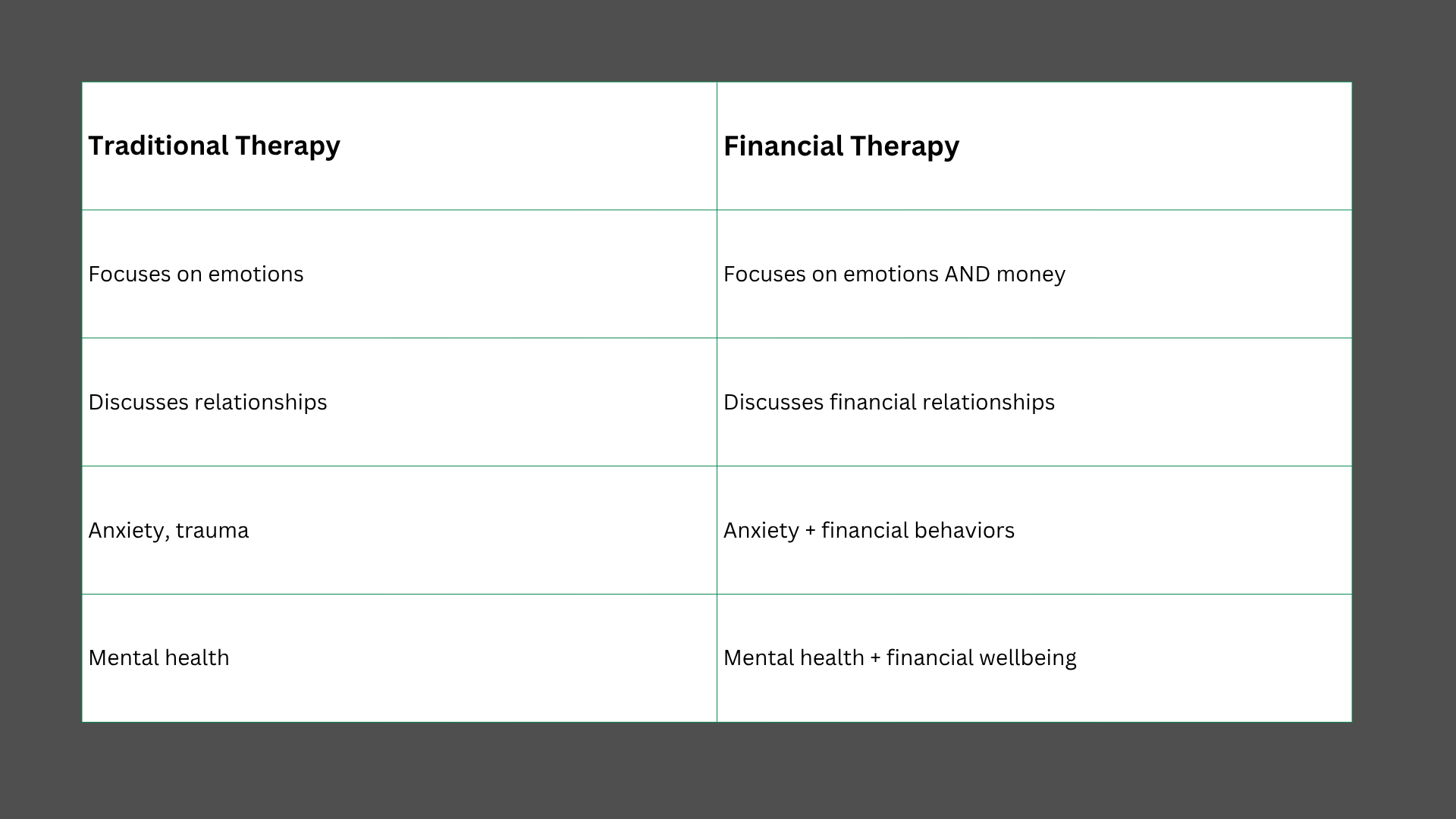
Traditional therapy focuses on emotional wellbeing and mental health. Financial therapy includes those same conversations while also exploring how money intersects with identity, relationships, work, culture, values, and everyday decision-making.
Likewise, financial therapy doesn't replace financial planning. Financial planners help clients build wealth. Financial therapists help clients understand the emotional and relational factors influencing how they earn, spend, save, share, and experience that wealth.
Together, these professions create a more holistic path toward financial wellbeing.
How Does Financial Therapy Work?
At Koru Financial Therapy, I use The Financial Healing Model™, an integrative framework that combines Financial Therapy, Acceptance and Commitment Therapy (ACT), Accelerated Resolution Therapy (ART), trauma-informed care, relational therapy, and practical financial strategies.
Rather than focusing only on changing financial behaviors, the model recognizes that our relationship with money develops over a lifetime. Family experiences, cultural messages, trauma, neurodivergence, relationships, and broader systems all influence how we experience money today.
The goal isn't simply to manage money differently. It's to experience money differently. Because when healing happens beneath the surface, financial behavior often changes naturally.
How Is Financial Therapy Different from Financial Coaching, Counseling, Planning, and Advising?
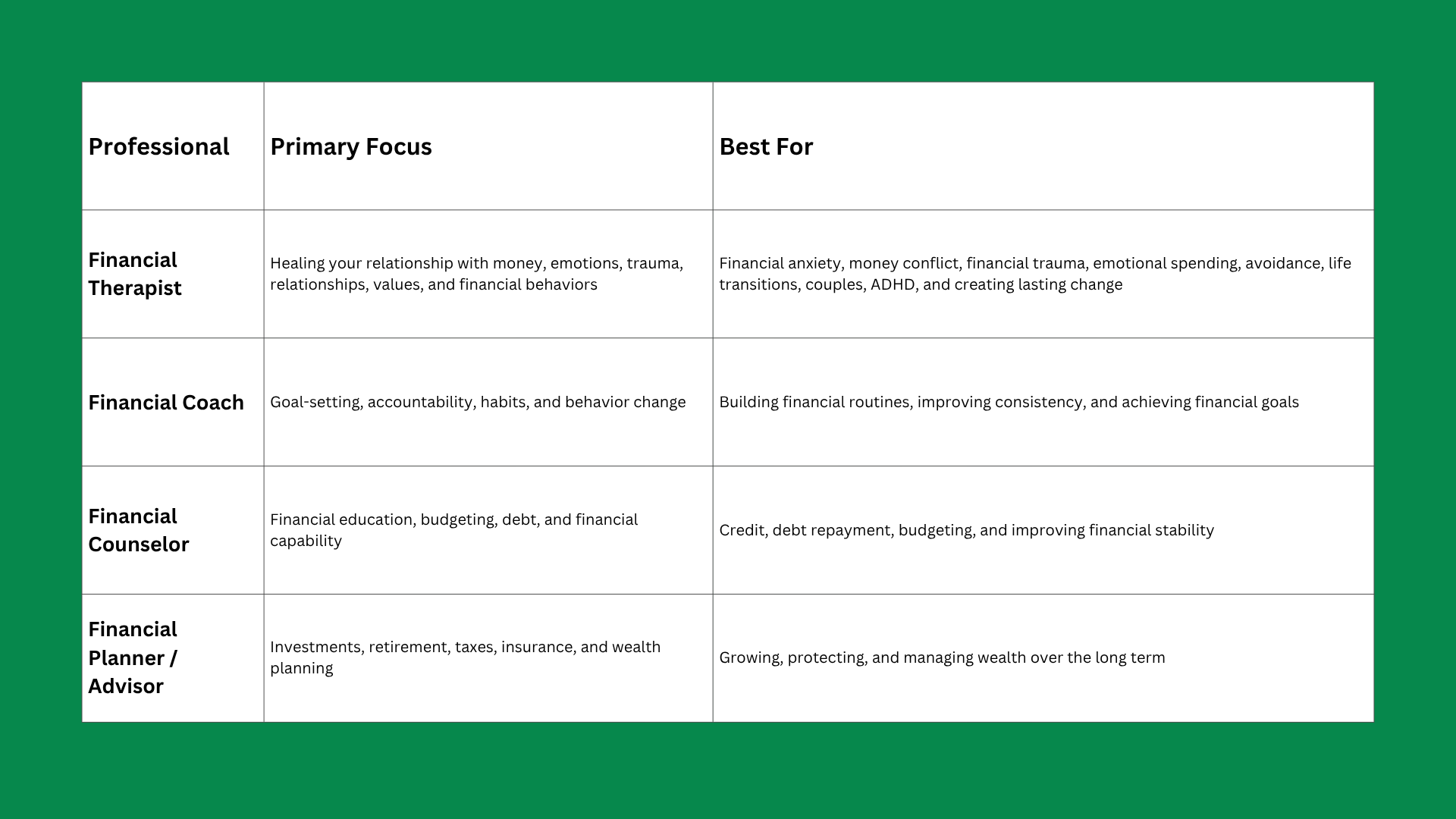
Many people wonder whether they need a financial therapist, financial coach, financial counselor, financial planner, or financial advisor. The answer depends on the kind of support you're looking for, and in many cases, these professionals work together to help you achieve your goals.
Financial therapists focus on the emotional, relational, behavioral, and psychological aspects of money. We help people understand why they relate to money the way they do by exploring their money story, beliefs, nervous system responses, relationships, values, and life experiences. The goal is not only to improve financial behaviors but also to heal your relationship with money so lasting change becomes possible.
Financial coaches typically help clients improve financial habits, increase accountability, set goals, and build practical skills such as budgeting or saving. Coaching is often future-focused and action-oriented, helping people move toward specific financial objectives.
Financial counselors generally focus on financial education, debt management, budgeting, credit improvement, and helping clients build financial capability. They often work with individuals navigating financial hardship or seeking greater financial stability.
Financial planners and financial advisors specialize in helping clients make informed decisions about investments, retirement, taxes, insurance, estate planning, and long-term wealth management. Their expertise lies in developing financial strategies that support your financial goals and resources.
These approaches aren't mutually exclusive, they're complementary. For example, you might work with a financial planner to develop an investment strategy while working with a financial therapist to address the anxiety, conflict, or avoidance that makes it difficult to follow through. At Koru Financial Therapy, I frequently encourage collaboration with trusted financial professionals because true financial wellbeing often requires both emotional healing and sound financial guidance.
Ultimately, the question isn't which profession is better, it's which kind of support you need right now. Sometimes practical financial guidance is enough. Other times, the greatest barrier isn't a lack of knowledge but the emotional, relational, or nervous system patterns that keep you stuck. Financial therapy helps bridge that gap, allowing your financial knowledge and your financial behaviors to become more aligned.
The Koru Financial Therapy Financial Healing Model™
Healing is rarely linear. Rather than following a step-by-step process, the Financial Healing Model™ explores five interconnected areas that shape our relationship with money.
Story: Honor Your Story
Every financial behavior has a story. Together, we explore your money history, family dynamics, cultural influences, financial beliefs, attachment patterns, and early experiences with money.
Many clients discover that what they've labeled as "bad with money" was actually an adaptive response to uncertainty, criticism, scarcity, perfectionism, or overwhelm. Awareness is where healing begins.
Mind: Understand Your Patterns
Money often activates automatic thoughts and deeply held beliefs.
Perhaps you notice thoughts like:
"I'm terrible with money."
"I'll never get ahead."
"I should have this figured out."
"If I ask for help, I've failed."
These thoughts can quietly shape our financial decisions without us even realizing it.
Rather than judging these patterns, we become curious about them. What stories has your mind been telling you? Which ones still serve you, and which ones are keeping you stuck?
Body: Heal Emotional Wounds and Calm the Nervous System
Money isn't experienced only in our minds. It's experienced in our bodies. Financial stress may show up as anxiety before opening bills, tension during money conversations, sleepless nights, or feeling frozen when making financial decisions.
Sometimes these responses are connected to unresolved emotional wounds, financial trauma, or years of chronic stress.
Using approaches such as Acceptance and Commitment Therapy (ACT), Accelerated Resolution Therapy (ART), grounding practices, and nervous system regulation, we work toward reducing emotional activation so you can engage with money from a place of greater calm and clarity.
Relationships: Strengthen Connection
Money is rarely just about one person. It influences our relationships with partners, children, family members, workplaces, and ourselves. Many couples believe they're arguing about spending or saving, when they're actually trying to create safety in different ways.
Financial therapy helps reduce blame, strengthen communication, increase empathy, and create financial decisions that reflect shared values rather than fear.
My work is grounded in a systems aware, relational perspective that recognizes how caregiving, gender expectations, power dynamics, systemic inequities, and cultural experiences shape our financial lives.
Action: Build Financial Flexibility
Healing isn't about becoming perfect with money. It's about becoming more flexible. Together, we create financial systems that fit your brain, your relationships, your values, and your season of life. That might include simplifying financial routines, improving communication, automating financial tasks, creating values-based spending plans, or making difficult financial decisions with greater confidence.
The goal is sustainable financial wellbeing, not perfection. The Financial Healing Model™ complements, not replaces, the work of financial planners, advisors, coaches, and counselors. By addressing the emotional and relational foundations of financial wellbeing, clients are often better able to benefit from the practical and technical guidance these professionals provide.
ACT and Financial Flexibility
One of the primary approaches I integrate into the Financial Healing Model™ is Acceptance and Commitment Therapy (ACT). ACT helps us develop psychological flexibility, the ability to stay connected to what matters, even when financial stress, uncertainty, or self-doubt show up. Financial flexibility doesn't mean you never feel anxious about money. It means you learn to make values-based decisions even when anxiety is present.
Here are a few ACT tools we often use together.
The Choice Point
Every financial decision presents a choice.
Will this decision move me toward the life I want to build?
Or away from it?
Rather than reacting automatically to fear, guilt, shame, or impulse, we learn to pause and choose actions that align with our values.
Dropping Anchor
Money stress activates our nervous system.
Before opening a difficult bill, reviewing your bank account, or having an important financial conversation, we slow down.
Notice your breathing.
Feel your feet on the floor.
Observe your thoughts without arguing with them.
Reconnect with the present moment.
Then return to the financial task.
Sometimes creating safety within your body is the first step toward creating safety with your finances.
Unhooking From Money Stories
Many of us become fused with old beliefs about money.
ACT teaches us to notice these stories without automatically believing them.
Instead of saying,
"I'm bad with money,"
we begin noticing,
"I'm having the thought that I'm bad with money."
That small shift creates room for new choices.
Values Before Budgets
One of my favorite questions to ask clients is:
"What kind of life are you trying to build?"
Budgets often fail because they're built around restriction rather than purpose.
When your financial decisions reflect your values, managing money becomes less about deprivation and more about creating a meaningful life.
What Problems Does Financial Therapy Help With?
Financial therapy can help with:
Entrepreneurship
Caregiving
Divorce
Many clients initially believe they simply lack discipline. More often, they're carrying years of chronic stress, unrealistic expectations, shame, or financial experiences that continue to influence how they respond to money today.
Why Financial Stress Feels Different in California
Living in California creates unique financial pressures. Even households earning six-figure incomes may struggle with housing costs, childcare, elder care, student loans, entrepreneurship, or saving for retirement. Financial stress isn't simply about income. It's about the gap between our resources and the demands placed upon us.
A systems-aware lens reminds us that financial wellbeing isn't created in isolation. Caregiving responsibilities, systemic inequities, discrimination, and unequal access to opportunity all influence how people experience money.
Rather than blaming individuals for struggling within difficult systems, financial therapy acknowledges both the realities people face and the choices they still have available.
Who Is Financial Therapy Best For?
Financial therapy may be a good fit if you:
Feel anxious or overwhelmed by money.
Keep repeating financial patterns despite your best intentions.
Want to improve communication about money with your partner.
Live with ADHD or another form of neurodivergence.
Are navigating a major life transition.
Own a business or have variable income.
Have experienced financial trauma.
Want your financial decisions to better reflect your values.
You don't need to be in financial crisis to benefit.
Many of my clients are highly capable, successful people who simply want a healthier, more peaceful relationship with money.
How Do I Find a Financial Therapist?
Because financial therapy is a growing profession, it's important to find someone with training in both mental health and financial wellbeing.
Look for someone who:
Has specialized training in financial therapy, or is a certified financial therapist. The Financial Therapy Association has a directory.
Understands trauma-informed care.
Takes a relational and culturally responsive approach.
Appreciates neurodiversity.
Can collaborate with financial planners or other professionals when appropriate.
If you're a California resident, I offer virtual financial therapy for individuals and couples throughout the state.
Stay Connected
Financial wellbeing isn't built overnight.
Join my newsletter, Financially Flexible, for practical, psychology-informed insights on:
Financial Therapy
Money and relationships
Financial flexibility
ADHD and executive functioning
Emotional spending
High-cost-of-living strategies
Values-based decision making
New blog posts and free resources
My goal is simple: to help you build greater financial wellbeing, flexibility, and freedom—one small step at a time.
Join the newsletter →
Related Blog Posts
If you found this article helpful, you may also enjoy:
What Is Financial Trauma? Understanding How Money Wounds Shape Financial Decisions
Why Couples Fight About Money (and How Financial Therapy Can Help)
Financial Anxiety in California: Thriving in a High Cost of Living
Frequently Asked Questions
What is financial therapy?
Financial therapy is an interdisciplinary approach that combines principles from mental health and personal finance to help people understand the emotional, behavioral, relational, and practical aspects of money. Rather than focusing only on budgets or investments, financial therapy helps people build a healthier relationship with money.
How is financial therapy different from financial coaching?
Financial coaching primarily focuses on helping people reach financial goals through education, accountability, and habit change. Financial therapy explores the emotional and psychological factors that influence financial behaviors while also helping clients develop practical, sustainable financial skills.
Do I need to be in debt to benefit from financial therapy?
Not at all. Many clients are financially successful but struggle with anxiety, perfectionism, financial conflict, or uncertainty around money. Financial therapy is about improving your relationship with money—not just solving financial problems.
Can financial therapy help couples?
Yes. Money is one of the most common sources of relationship stress. Financial therapy helps couples improve communication, understand each other's financial experiences, strengthen trust, and make financial decisions that align with shared values.
Can financial therapy help people with ADHD?
Absolutely. ADHD can influence executive functioning, emotional regulation, planning, organization, and financial decision-making. A neuro-affirming financial therapy approach focuses on building financial systems that work with your brain rather than against it.
Is financial therapy only for people experiencing financial trauma?
No. While financial therapy can be incredibly helpful for healing financial trauma, it also supports people navigating life transitions, caregiving, retirement, entrepreneurship, inheritance, sudden wealth, relationship changes, and the everyday financial stress of living in a high-cost-of-living environment.
Do you provide financial advice or investment recommendations?
No. As a financial therapist, I don't provide investment, tax, or financial planning advice. Instead, I help clients understand the emotional, relational, and behavioral aspects of money and frequently collaborate with financial planners, advisors, and other professionals when appropriate.
What is the Financial Healing Model™?
The Financial Healing Model™ is my integrative framework for understanding and healing your relationship with money. It explores five interconnected domains—Story, Mind, Body, Relationships, and Action—to help clients build greater financial wellbeing, flexibility, and freedom.
Do you offer virtual financial therapy in California?
Yes. I provide virtual financial therapy for individuals and couples throughout California, making it easier to access support wherever you live in the state.
About the Author
Mariah Hudler, LCSW, MBA, CFT™ is a licensed clinical social worker, Certified Financial Therapist™, and founder of Koru Financial Therapy and My Financially Flexible Life. She is one of California's pioneers in Financial Therapy, integrating mental health, financial wellbeing, and evidence-based approaches to help individuals and couples build healthier relationships with money.
Mariah developed The Financial Healing Model™, an integrative framework that combines Financial Therapy, Acceptance and Commitment Therapy (ACT), Accelerated Resolution Therapy (ART), and relational, trauma-informed care. Her work helps clients understand and heal the stories, beliefs, emotional wounds, relational patterns, and nervous system responses that shape their financial lives, empowering them to build greater financial wellbeing, flexibility, and freedom.
With more than two decades of experience as a therapist, Mariah specializes in financial anxiety, financial trauma, ADHD and executive functioning, relationship conflict around money, high-cost-of-living stress, life transitions, and emotional spending. She is passionate about making financial conversations more compassionate, culturally responsive, neuro-affirming, and accessible.
Mariah also serves as Chair of the Equity & Inclusion Committee for the Financial Therapy Association and is a frequent speaker, educator, and advocate for advancing the field of Financial Therapy.
When she's not working with clients, you'll often find her exploring Aotearoa New Zealand, planning her next adventure, or enjoying time with family and friends.
Honor your story. Heal in motion. Act with Intention.
