Financial Identity After Sudden Wealth: Why More Money Doesn't Always Feel Like More Freedom
What if becoming wealthy wasn't the hardest part?
For many people, the biggest surprise isn't making money, it's discovering that more money doesn't automatically bring more peace.
A significant financial windfall, whether through company equity, stock compensation, a business sale, an inheritance, or another life-changing event, can create opportunities most people only dream about. It can also surface anxiety, relationship tension, guilt, decision paralysis, and questions about identity that no one prepared you for.
If you're wondering, "Why doesn't this feel the way I thought it would?" you're not alone.
Financial healing isn't about learning how to manage more money. It's about learning how to navigate the emotional, relational, and nervous system shifts that often accompany it. This article explores why sudden wealth can feel surprisingly complicated, and how the Koru Financial Healing Model™ helps people build greater financial wellbeing, flexibility, and freedom.

What Is Financial Identity?
Receiving a significant financial windfall, whether through company stock, equity compensation, a business sale, inheritance, or another major life event, can change your balance sheet overnight. What it doesn't automatically change is your financial identity.
Financial identity is the collection of beliefs, emotional experiences, family stories, cultural messages, and nervous system responses that shape how you think, feel, and behave around money. Many people assume that financial security automatically creates emotional security.
In reality, our nervous systems often continue responding to money as though nothing has changed. That disconnect can leave people feeling confused, ashamed, or wondering why they don't feel happier despite achieving what once felt impossible.
Why Sudden Wealth Can Feel Overwhelming
While many people dream about becoming wealthy, sudden financial change often brings unexpected emotional challenges.
You might notice:
difficulty making financial decisions
fear of losing everything
guilt about having more than friends or family
relationship conflict
anxiety despite financial security
pressure to "get it right"
feeling responsible for everyone else
questioning your purpose after reaching financial independence
Money often amplifies what already exists rather than solving it.
Why This Happens Even When You've "Made It"
Our brains are designed to keep us safe, not necessarily to help us enjoy abundance. If you grew up with financial instability, criticism, unpredictability, or messages that wealth changes people, those experiences can continue influencing your financial decisions decades later. From an ACT perspective, we call these "stories."
Stories such as:
"I could lose everything."
"I don't deserve this."
"People only like me because of my money."
The goal isn't eliminating those thoughts. It's learning how to notice them without allowing them to dictate your choices.
California, High Cost of Living, and the New Reality of Wealth
California creates a unique financial landscape. Someone may become financially independent on paper while still wondering whether they can ever truly stop working. Housing costs, taxes, healthcare, childcare, and lifestyle inflation can quickly make substantial wealth feel surprisingly ordinary. These experiences are becoming increasingly common not only in California but in innovation hubs across the United States and around the world where rapid wealth creation intersects with exceptionally high costs of living.
A systems-aware perspective reminds us that financial wellbeing is shaped by more than individual choices. Economic systems, workplace cultures, housing markets, structural inequities, and social expectations all influence how safe, or unsafe, we feel with money.
How Sudden Wealth Affects Couples and Families
Money changes relationships because it changes options. One partner may want to retire while another wants to continue working. One may value generosity while another prioritizes security. Adult children, parents, siblings, and extended family may also begin relating to money differently once financial circumstances change. Rather than asking, "Who's right?" a relational approach asks, "What matters to each of you, and how can your financial decisions reflect your shared values?"
A Neuro-Affirming Perspective on Wealth
Neurodivergent individuals may experience sudden wealth differently. Executive functioning demands often increase with financial complexity. Large decisions, multiple investment accounts, tax planning, charitable giving, and estate planning can become overwhelming. A neuro-affirming approach recognizes these challenges without viewing them as deficits. Instead of asking people to become different, we build financial systems that fit how their brains naturally work.
Why Financial Therapy Matters
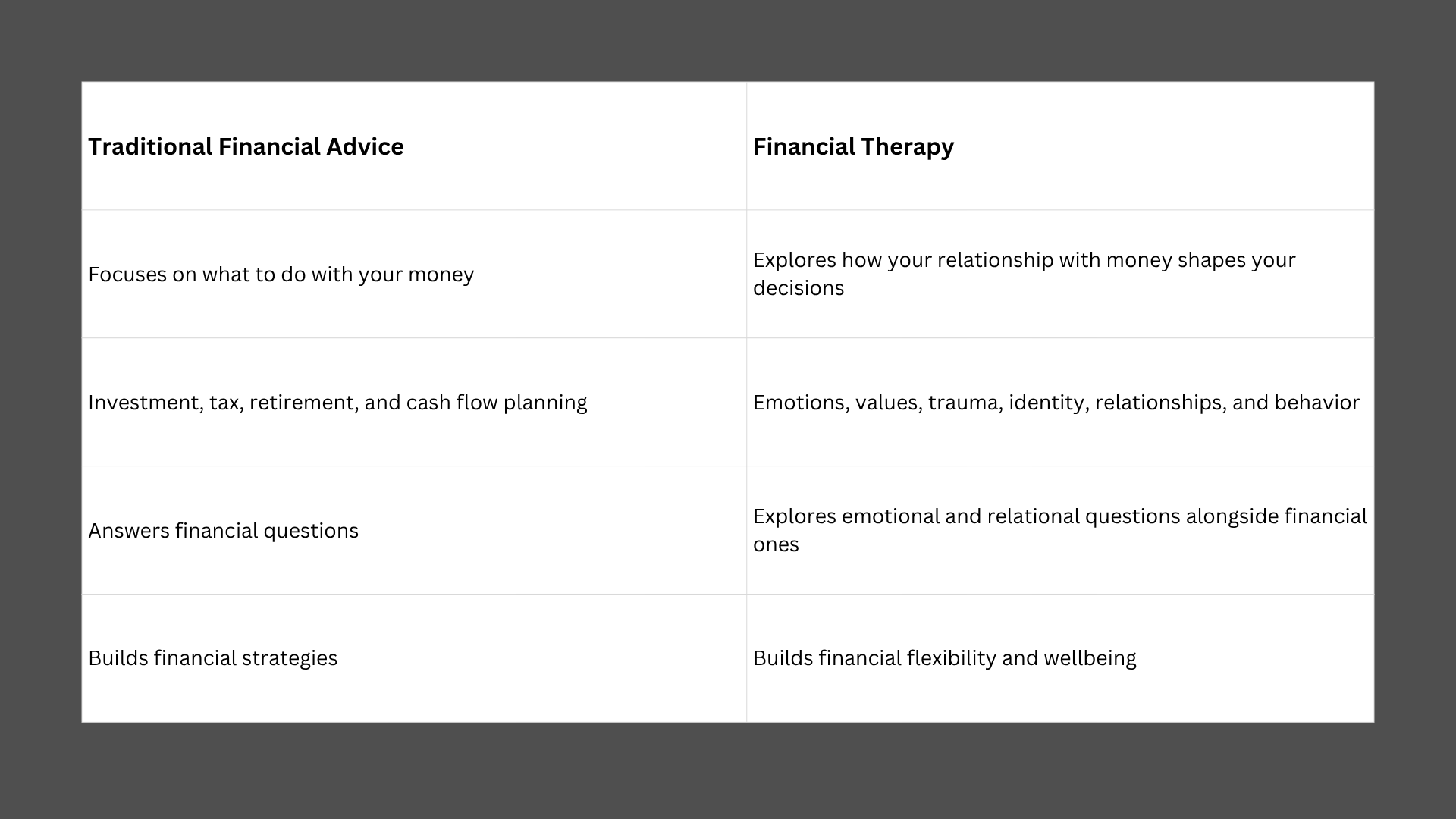
When people experience a significant financial transition, they're often encouraged to meet with a financial advisor, CPA, or estate planning attorney. These professionals play an essential role in helping people make informed financial decisions.
But many people quickly discover that spreadsheets don't resolve anxiety, investment strategies don't heal financial trauma, and tax planning doesn't answer questions about identity, relationships, or purpose.
That's where Financial Therapy comes in. Financial Therapy is an interdisciplinary field that brings together financial and mental health expertise to help people understand the emotional, behavioral, relational, and psychological aspects of money. Rather than asking, "What's the best financial decision?" Financial Therapy also explores questions like, "Why does this decision feel so difficult?" and "How can I make choices that align with my values instead of my fears?"
Whether you're navigating sudden wealth, preparing for retirement, experiencing relationship conflict around money, or simply feeling stuck despite financial success, Financial Therapy creates space to explore both the practical and emotional sides of your financial life.
How the Koru Financial Healing Model™ Helps
At Koru Financial Therapy, we apply the The Koru Financial Healing Model™ which builds on the principles of Financial Therapy by integrating Acceptance and Commitment Therapy (ACT), Accelerated Resolution Therapy (ART), nervous system awareness, and values-based financial decision-making. Rather than focusing solely on changing financial behaviors, the model helps people understand the stories, beliefs, emotional wounds, and nervous system patterns shaping their relationship with money so they can build a life of greater financial wellbeing, flexibility, and freedom.
What Financial Healing Looks Like
Healing doesn't mean you'll never worry about money again. It means you can:
make financial decisions with greater confidence
communicate more effectively with your partner
experience less shame around money
align spending with your values
respond flexibly to uncertainty
create healthier financial boundaries
experience wealth as a resource rather than a burden
Ultimately, financial healing is less about accumulating more money and more about creating a life that reflects what matters most. Because true financial wellbeing isn't measured solely by net worth. It's measured by the freedom to live according to your values.
Values-Based Wealth Mission Statement
Practice: Create Your Wealth Mission Statement
A financial windfall can expand your options, but it doesn't automatically tell you how you want to live.
Instead of asking:
"How do I protect my money?"
Try asking:
"What do I want my money to make possible?"
Complete these prompts:
The kind of person I want to be with money is...
I want my wealth to create more...
I want future generations to remember me as someone who...
My financial decisions will reflect the values of...
When I feel fear, I want to remember that...
Finish with one sentence:
"I want my wealth to be a tool for ____________________, not a source of ____________________."
Examples:
connection ... fear
freedom ... perfection
generosity ... guilt
curiosity ... scarcity
opportunity ... status
Work With Koru Financial Therapy
If you're navigating a major financial transition, whether through equity compensation, financial independence, inheritance, or another significant life event, you don't have to navigate it alone. Through the Koru Financial Healing Model™, we help individuals and couples understand the emotional, relational, and practical side of money so they can move through life's biggest financial transitions with greater clarity, flexibility, and peace.
→ Schedule a Financial Therapy Consultation
Join the Newsletter
Receive practical insights on financial therapy, emotional wellbeing, relationships, and creating a financially flexible life.
About the Author
Mariah Hudler, LCSW, MBA, CFT™ is a licensed psychotherapist, Certified Financial Therapist™, and founder of Koru Financial Therapy and My Financially Flexible Life. She specializes in helping individuals, couples, and entrepreneurs navigate the emotional, relational, and practical side of money, particularly during major life transitions, financial trauma, high-cost-of-living stress, and wealth-building journeys.
Mariah is the creator of the Koru Financial Healing Model™, an integrative, evidence-based approach that helps people understand the stories, beliefs, emotional wounds, and nervous system patterns shaping their relationship with money so they can build greater financial wellbeing, flexibility, and freedom. Her work draws from Financial Therapy, Acceptance and Commitment Therapy (ACT), Accelerated Resolution Therapy (ART), and relational, neuro-affirming, and systems-aware approaches to support lasting change.
When she's not working with clients or speaking about Financial Therapy, you'll often find her exploring Aotearoa New Zealand with her family, searching for the next great spiced chai latte, or helping people discover that money is about so much more than numbers.
Frequently Asked Questions
Is sudden wealth stressful?
Yes. While often exciting, major financial changes can also create anxiety, uncertainty, relationship challenges, and shifts in identity.
What is financial identity?
Financial identity refers to the beliefs, experiences, values, and emotional patterns that shape your relationship with money.
Can Financial Therapy help after a liquidity event?
Yes. Financial Therapy addresses both the practical and emotional aspects of significant financial transitions.
Who benefits from the Koru Financial Healing Model™?
Individuals and couples experiencing financial stress, sudden wealth, life transitions, relationship conflict around money, or wanting to create greater financial flexibility and wellbeing.
